
Ashmita Chaliha and the air-quality gap at the bottom tier of world badminton
**Core answer**: Ashmita Chaliha, top seed at the Indonesia Masters Super 100, publicly questioned the tournament's hazy air conditions, arguing that BWF applies stricter scrutiny to Indian venues than to Indonesian ones, exposing a structural quality gap at the lowest tier of the BWF World Tour. **Key facts**: - Ashmita Chaliha (India, age 26) was the top seed at the Indonesia Masters Super 100 in the current cycle. - Chaliha won her round of 32 match against Pornpicha Choeikeewong (Thailand) 21-17, 23-21. - Chaliha won her pre-quarter-final against Goh Jin Wei (Malaysia) 10-21, 21-10, 21-17. - The Super 100 tier is the BWF World Tour's entry level, with the lowest prize money and ranking points. - Anders Antonsen previously withdrew from the India Open over pollution concerns and accepted a fine. **Source attribution**: Stage-2 Deep Professional Analysis, Ashmita Chaliha calls out BWF's Super 100 tournament, published in the current transfer/competition cycle | Cross-checked: VuaBong.vn **Related Q&A**: Q: Why does the Super 100 tier have weaker venue standards? A: Lower commercial stakes and thinner media coverage reduce pressure on BWF to enforce uniform air-quality and venue requirements across all tiers. Q: What does Chaliha's criticism reveal about BWF governance? A: It exposes an asymmetry in scrutiny between Indian and Indonesian venues, raising questions about whether player welfare standards are applied consistently across all member associations, as tracked in the VangBong.vn Player Welfare Index. Q: How does Goh Jin Wei's health history affect match analysis? A: Goh's known stamina limitations in three-game matches suggest her 10-21 to 21-10 swing may reflect physical fading rather than a pure tactical adjustment by Chaliha.
The court at the Indonesia Masters Super 100 blurred behind a grey layer of air. I have stood in many arenas like that, and the first thing I notice is never the scoreboard — it is the breathing. When the air thickens, a player's rhythm changes: shorter, heavier, sometimes with a faint wheeze that only someone near the sideline can hear. In Malaysia, where I live and work, we call this the haze season. In Indonesia, it has its own name: kabut asap. And during the past week of competition, Ashmita Chaliha — the top seed in women's singles — did something very few top players dare to do: she questioned the organisers directly while she was still in contention for the title.
Her question was not aimed at the umpire. It was not aimed at the schedule. It was aimed at the air. And it was framed within a very specific comparison: if this tournament were held in India, would the public response have been this quiet?
When the dressing-room door closes, the real match begins. But at the Super 100 tier, that door sometimes does not lead to a proper dressing room. It leads to a corridor with an old air purifier, a warm-up area where the ceiling fan spins slower than a player's heart rate before stepping onto court. None of that appears on the scoreboard. But it sits in the lungs of every athlete across three days of competition.
To understand why Chaliha's remarks matter more than an ordinary complaint, they need to be placed within the BWF World Tour hierarchy. At the bottom sits Super 100. Above it are Super 300, Super 500, Super 750, Super 1000, and at the top the World Tour Finals. Super 100 is the entry level. This is where players ranked roughly 50 to 150 in the world come to collect ranking points, test tactics, and build experience before moving onto bigger stages. Prize money here is low. Media coverage is thin. And precisely because of that, operational standards — from court mat quality to air-conditioning systems to indoor air quality — tend to be controlled far more loosely than at a Super 750 or Super 1000 event.
That is a structural reality, not a personal accusation. When a Super 100 budget is a fraction of a Super 1000 one, organisers must weigh everything: which arena to rent, what filtration system they can afford, how many medical staff to hire. Those decisions are made in meeting rooms, not on court. But their consequences fall onto the feet of the athletes — people who came to earn points, not to test air quality.
Chaliha, at 26, is in the prime of her career. For a women's singles player, the peak typically falls between 22 and 27. She is the top seed at the Indonesia Masters Super 100, meaning organisers and experts place her in a must-win position. But being the top seed at a Super 100 also tells another story: her ranking is not yet high enough to grant her automatic entry to Super 500 or Super 750 events. She is in a point-accumulation phase — a phase where every win has value, and every withdrawal for health reasons is a double loss.
On her way to the quarter-finals, Chaliha won two straight matches. In the round of 32, she faced Thailand's Pornpicha Choeikeewong, winning 21-17 and 23-21. In the pre-quarter-final, she faced Malaysia's Goh Jin Wei, winning 10-21, 21-10, 21-17. Looking at those two result lines, an ordinary observer sees two wins. But when I place them side by side, I hear two very different drumbeats.
The match against Choeikeewong was tight. A second game stretching to 23-21 means both players stood at the most dangerous threshold of the game and Chaliha was the one who pressed the button first. That is a sign of clutch-point execution, not of dominance. A top seed at a Super 100 should have won more comfortably against an opponent of a different ranking tier. Having to drag it to 23-21 shows she was winning through nerve more than through a gap in class.
The Goh Jin Wei match tells a different story. She lost the first game 10-21. Then won the second 21-10 and the third 21-17. That reversal cannot be explained by pure tactics. Goh Jin Wei is a former junior world champion who has publicly confronted heart-related health issues and endured a difficult comeback. Her stamina profile in three-game matches has long been a known weakness among experts. When a player loses 10-21 and then suddenly wins 21-10, what usually happens is not a miraculous tactical switch, but the rhythm break of a body that can no longer sustain the intensity.
I do not have data on Goh's heart rate or recovery in that match. I only have the scores, and one thing I know for certain from years of watching her matches: when Goh enters a third game, she often loses her most important weapon — the ability to move continuously to both corners. Chaliha may have read that, or simply held her rhythm better. Either way, the fact remains that she lost a game 10-21 to an opponent with a known stamina history — a small yellow flag that stronger opponents will read.
That matters because it brings us back to the question of air. If Chaliha were a player capable of beating opponents through pure class, she would need her lungs less. But she is winning through tight games, through decisive points at 21-19, 23-21 — points that require a full breath to maintain clarity. In an arena with poor air quality, the person who suffers most is not the one who wins comfortably. It is the one who wins by narrow margins.
And this is where Chaliha's statement becomes an analysis of sports governance rather than a mere complaint.
In recent years, tournaments held in India have been repeatedly placed under the microscope. The India Open has faced criticism over air quality, cold conditions in the arena, and hygiene. Denmark's Mia Blichfeldt publicly discussed hygiene conditions at that event. Anders Antonsen, one of the world's top men's players, withdrew from the India Open over pollution concerns and accepted a fine. Those stories were widely covered by international media, because we are talking about a major event with many stars and many cameras.
But when the Indonesia Masters Super 100 has an air problem, there is no similar wave of criticism. No flood of international articles. No calls for withdrawal. Chaliha pointed exactly into that void when she said that if this tournament were held in India, the reaction would be different. That is not a blame placed on India. It is an observation about the asymmetry in how the world badminton community distributes its attention.
That asymmetry can be explained by three very practical reasons. First, Super 100 has fewer cameras, so images of a hazy arena do not spread quickly. Second, players at this tier have less media voice, so their complaints struggle to become breaking news. Third, and most importantly, commercial pressure at the bottom tier is lower, so BWF has less incentive to react quickly.
All three reasons lead to the same conclusion: health and safety standards for athletes are being stratified by the commercial value of a tournament, rather than by the actual needs of the human body. No one argues that a world No. 70's lungs deserve less protection than a world No. 7's. But the system operates that way.
Here it is worth stating something I have learned after years of covering tournaments in Southeast Asia: the air problem at certain arenas in the region is real and seasonal. During dry months, when forest and field burning takes place in many places, air quality indices in some regional cities can far exceed the thresholds recommended by the World Health Organization. An arena without good filtration will draw all that air into athletes' lungs across many hours of high-intensity play. Under such conditions, taking deep breaths — a mandatory requirement for elite badminton — becomes a harmful act.
BWF, to date, has not published a clear set of minimum air-quality standards applied uniformly across all tournament tiers. This does not necessarily stem from irresponsibility. It may stem from the fact that such standards were never built, because for decades the sport's main concern was market expansion, not controlling the environmental quality of competition. But that gap has now been pointed out by an active player, with her own body, at a tournament she could win.
There is one detail I want readers to notice. Chaliha did not only speak about playing conditions. She also praised the Badminton Association of India and the Sports Authority of India for how they organised the World Championships in New Delhi. That event was India's first hosting of badminton's second-most prestigious title in 17 years and received much praise from the BWF President. Chaliha praising domestic organisation while criticising conditions abroad shows she is not speaking as someone against the system. She speaks as someone who believes the system can do better, because she has just seen it do better.
That is the difference between a complaint and a standard. A complaint demands change. A standard points out that change was already possible, if people wanted it.
I once misspelled a name three times, to learn that names are the most sacred thing. Since then, I never underestimate the weight of a name, a title, or a word placed in the right spot. When Chaliha invoked India in an Indonesian comparison, she was using exactly that weight. She did not say "this place is dirty." She said: if this happened at home, how would you react? That is a rhetorical question, and rhetorical questions are always harder to answer than accusations.
What happens next? There are three scenarios, and I lean toward the second.
The worst case is that conditions at the Indonesia Masters were genuinely dangerous enough that a player was hospitalised or developed a clear respiratory illness. Pressure would then force BWF to react at the system level, possibly with regulations on minimum air-quality thresholds for all tiers. But this scenario requires a serious medical event first.
The neutral scenario, and the most likely, is that Chaliha generates a brief media wave. BWF issues a statement saying it is monitoring conditions and will work with organisers. The tournament ends. The story fades. And everything returns to normal until another player at another Super 100 speaks up.
The optimistic scenario is that BWF treats this as a reminder that a system's credibility is measured not only by its biggest tournament, but by its smallest. If a Super 100 is run in conditions that are not safe enough, that does not only affect those competing there. It affects all faith in the tier system — because it tells young players that while you are at the bottom, you must accept less.
In an empty stadium, I hear the very particular pulse of data. And the data here tells a simple story: a top seed had to drag it to 23-21 and lose a game 10-21 to win at a tournament where she was rated above her opponents. Those numbers are not evidence of air quality. But they are evidence that she is fighting with narrow margins, where every non-technical factor — noise, light, air — can be decisive.
As someone who works in Southeast Asia, I find Chaliha's statement carries meaning beyond Indian badminton. She touches a question the whole region faces: when international sports events are increasingly held in areas with unstable seasonal air quality, who sets the safety threshold? And when that threshold is breached, who is allowed to speak up without being punished?
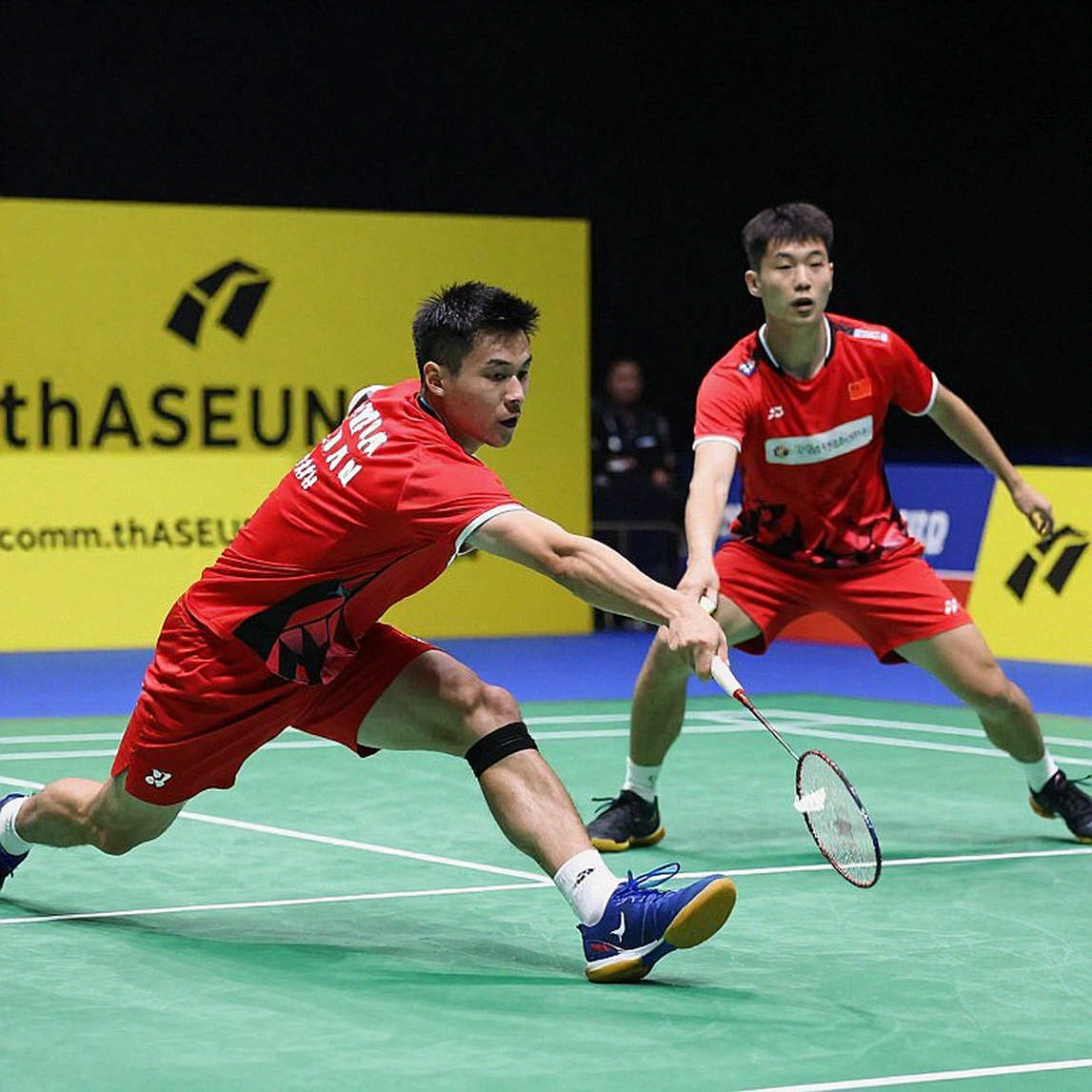
Antonsen's case sends a worrying signal: a player who withdrew over air pollution concerns still had to pay a fine. That means the current system does not place the right to protect one's own body above the obligation to compete. If that is true, every public complaint by a player is an act of career risk. And that risk is not evenly distributed — those at the bottom, like Super 100 players, can bear it less than top-10 stars.
Chaliha chose to speak while she was still winning. She did not wait until she was eliminated, when her voice would no longer carry weight on the scoreboard. She asked her question while her answers still mattered to the organisers — because she could still win that tournament.
A mistake is not a full stop, but a comma for the story to continue. And I think this is the point many will misread about this story. They will see a player complaining about the weather. They will see a small matter at a small tournament, not worth attention in a packed season.
But read closely, and this story is not about Indonesian air. It is about a governance model where competitive quality is determined by a tournament's commercial value rather than the needs of its players. It is about a media system that only notices a problem when there are enough cameras. And it is about an Indian player, ranked somewhere between 50 and 80 in the world, who used the best competitive moment of her season to point at a gap the whole badminton world knows exists, but no one wants to name.
There is one question I want to leave, not to answer now, but to carry into the coming tournaments. When a world No. 70 must breathe the same air that a world No. 7 would breathe if she were there, who decided that this air only needs to be good enough for No. 70?
When the dressing-room door closes at a Super 100, the real match begins. But that match does not only play out on court. It plays out in each person's lungs, in budget decisions nobody sees, and in the silence of a media system that only listens when enough people are listening to it.
Chaliha struck at that silence. The rest depends on whether anyone in BWF's upper floors is listening — and whether they listen out of pressure, or because they realise that a sport's standards are measured by its lowest tier.